 (2).png)
 3 hours ago
10
3 hours ago
10
On September 9 at 6:51 p.m., Harris County Judge Lina Hidalgo exited an ongoing budget meeting in protest. “Shame on you,” she scolded her colleagues—namely her fellow Democratic Commissioners Lesley Briones and Adrian Garcia, but also Republican Commissioner Tom Ramsey—after they refused to fund several early childhood education programs and a juvenile probation program. It appeared to be a continuation of a feud that had only deepened since the “GOP three,” as Hidalgo has dubbed them, forced through major pay increases for Harris County law enforcement.
At the time, Hidalgo left unsaid another reason she had to leave early: a concert featuring the trademark orchestral film scores of German composer Hans Zimmer, which was set to begin at 7:30 p.m. at the nearby Toyota Center. Later that night, Hidalgo confirmed on Instagram that she was indeed in attendance: “Food for the soul after fighting to keep colleagues from decimating county services for residents,” she wrote on her Instagram story. “We live to fight another day!”
For Hidalgo’s critics—of which today there are many, left and right—the optics of sidestepping her responsibilities as the top elected official in Texas’ most populous county to attend a concert was further proof that the once-longshot candidate-turned-shining Democratic star, erstwhile beacon of Texas’ blueing electorate, was not only ill-suited for the job. She didn’t even seem to want it anymore. Six days later, the 34-year-old, Colombia-born Hidalgo confirmed her critics’ suspicions, announcing she would not seek reelection. For the Houston Chronicle’s editorial board, the lessons from her tenure, which will last eight years, were simple: In Texas, the oddly titled county judge is indeed the county’s top executive, but the role’s power largely depends on goodwill among the other four members of what’s called the commissioners court. In other words, she should have played nicer, or at least smarter, with her colleagues. “Hidalgo was never a politician,” the board wrote. “Unfortunately, being a politician was her job.”
There’s some truth to this, but only in the way any other platitude (“everything happens for a reason”; “don’t bite the hand that feeds you”) purveys the obvious while smacking of sanctimony. And whereas progressives are right to emphasize the right’s high-powered propaganda mill that sought to tear Hidalgo to shreds—including by weaponizing her public transparency about her mental health—this also fails to appraise the county judge for what she was, or at least what she became.

With Houston progressives fated to suffer at least two more years of humiliation under 76-year-old blue-dog Democrat Mayor John Whitmire, watching feebly as the commissioners court blusters toward austerity, it’s worth lingering on Hidalgo’s double-edged legacy: a meteoric rise and a stumbling decline, a wave of Democratic empowerment followed by a striking bout of impotence.
As a Latina immigrant elected in her mid-twenties, Hidalgo faced unique headwinds that can’t be ignored when reckoning with her time in office, yet what she did with the power she won must still be judged on its own merits.
While much of the country may have learned of Hidalgo’s political decline in mid-September when The New York Times published its story on her choice not to run again, Hidalgo’s regime was, for the true believers in her office, already on uncertain ground during her 2022 reelection bid.
Then-District Attorney Kim Ogg, also nominally a Democrat, who assumed office in 2017, had announced what many saw as a politically motivated investigation into three of the judge’s former staffers for allegedly steering a COVID-19 contract to a political ally. (One of Hidalgo’s first acts in 2019 was to bolster the local public defender’s office and snub Ogg’s request for more prosecutors, arguably paving the war path that ended in Ogg’s 2024 primary ouster.) Multiple former Hidalgo staffers, who requested anonymity because they still work in local government, recalled a heavy sense of paranoia in Hidalgo’s office and on the campaign trail, as she tried to get out from under the ethics case that lingered for almost three years, until eventually even Attorney General Ken Paxton moved to drop it.
In what was one of the country’s most expensive local races, and the main proxy for the Texas state government versus its blue municipalities, Hidalgo narrowly prevailed in 2022 with a sub-2-percent margin—roughly the same difference by which she originally ousted a popular moderate Republican incumbent, Ed Emmett, as a well-educated neophyte to politics and government back in the blue-wave days of 2018.
Her narrow reelection was a bright spot in an otherwise dispiriting ’22 cycle for Democrats in Houston and Texas altogether. To Ginny Goldman, a former senior advisor to Hidalgo and longtime progressive strategist, the win could be attributed to the fact that Hidalgo shepherded the county through times of crisis—typically the most prominent role of the county judge in the disaster-prone Houston area. She acted as emergency executive during the ITC chemical fire in 2019, and, soon thereafter, the worst days of the COVID-19 pandemic and Winter Storm Uri, whose death toll exceeded even Hurricane Harvey’s. Before long, she would shepherd the county through derecho- and Hurricane Beryl-induced power outages and a chemical explosion in Deer Park.
Through it all, the right attacked her often for little more than her communicative style. In 2019, for instance, Republicans lambasted her for having the audacity to speak both English and Spanish at press conferences; by 2025, this had become a common occurrence across the commissioners’ court.
“She is a natural at communicating during disaster, which is when people most want the government to step in and keep them safe,” said Goldman.
 Hidalgo speaks at a March 2019 press conference after a Houston-area petrochemicals storage facility caught fire. (Godofredo A. Vasquez/Houston Chronicle via AP)
Still, Hidalgo’s mandate to govern had never looked shakier, despite Dems having secured a super-majority on the commissioners court. If once she was a political outsider, Hidalgo now suffered from the same lack of enthusiasm as your typical establishment Democrat.
Her office had already drifted far from its roots. Following her upset victory in 2018, she and her aides hit the ground running. In the two months leading up to the swearing-in ceremony in January 2019, Hidalgo, plus soon-to-be Precinct 2 Commissioner Adrian Garcia and Precinct 1 Commissioner Rodney Ellis, met every week to discuss their shared priorities. Her team continued knocking on thousands of doors, asking people how the government could help everyone live with dignity. Along with more than 200 other civic organizations, Hidalgo scheduled “Talking Transition” workshops anyone could show up to help define her priorities.
The plan was to build “Lina’s Army,” as her team dubbed it, out of these newly activated residents.
In short order, the trio of Dem commissioners injected funds into that cash-starved public defender system, developed a plan to increase the minimum wage for county employees, and earmarked funds for equitable flood infrastructure by prioritizing low-income communities that had long been left behind.
More than that, Hidalgo strove to make good on a campaign promise: to build a “county that works for everyone.” Harris County government had, for decades, been ruled behind closed doors by the business elite, and for a brief moment under Hidalgo the walls between the government and the masses had never seemed so permeable. Hidalgo even promised to never take campaign donations from any contractors, a pledge no other county commissioner ever joined in on (and on which she later reneged).
While her style of governance in her first term was not exactly populist, it was intentionally grounded in progressive ideals. But even that wouldn’t last.
Entering her second term, Hidalgo’s style became ever more insular and technocratic, her decision-making more divorced from the grassroots.
“It was kind of a natural response” to the right-wing campaign against her, said Ben Hirsch, co-director of West Street Recovery, a progressive Houston nonprofit focused on climate change resilience. West Street and Hidalgo didn’t always have an easy relationship. In fact, as early as 2019 the group was critical of Hidalgo’s governing strategy regarding the county’s flood control infrastructure, which the group believed prioritized well-off areas over low-income neighborhoods. But they did have a working relationship in her first term.
Gradually, though, Hidalgo’s camp stopped showing up to West Street’s community events. From late 2021 onward, “It was clear Hidalgo’s office was more closed” to outside advocates, Hirsch said—that is, at least until this last budget fight, when the two were thrust onto the same side against the funding cuts.
In Hirsch’s view, Hidalgo’s relationship with the grassroots was always somewhat tenuous. “I personally really like her,” he said, “but she was never a movement candidate.” While she was sympathetic to local progressive groups, she didn’t always fully buy into their various agendas. That, of course, didn’t stop her powerful Republican critics from branding her as a left-wing radical. “Sometimes I wish the Lina that Ken Paxton thinks existed actually existed,” Hirsch said.
Take, for instance, the Houston ISD bond election in 2024. While public energy against the state takeover of HISD escalated across Harris County led by parents, public ed advocates, and allies like the Houston Federation of Teachers, local Democrats and Republicans found rare common ground in opposing the massive $4.4-billion bond measure for the state-run HISD.
Hidalgo, meanwhile, was one of the only local elected officials to come out in favor of the bond, ostensibly lending her support to the highly controversial state-appointed superintendent Mike Miles. “I will continue to advocate for increased community involvement, meaningful engagement and, most importantly, the end of the TEA takeover,” Hidalgo said then in a statement. “At the same time, I believe crucial investments are needed in our schools and cannot wait.”
The bond proposal became the school district’s first to fail in 28 years, a resounding victory for the 58 percent of Houstonian voters who, in part, had reasoned that signing off on Miles’ bond agenda would only strengthen the takeover. But Hidalgo could claim no part in it.
“This is what happens when you remove yourself from engaging with organized groups of people,” Goldman, who left Hidalgo’s employ at the end of 2022, told the Observer.
In the first year of her second term, Hidalgo’s staff also fled for the exits. Between January and August of 2023, Hidalgo lost about a third of her 30-some staffers, according to interviews and a review of LinkedIn profiles. Most went to work for the newest Democratic commissioner, Lesley Briones, who won Precinct 4 in 2022 thanks to the court’s redrawing of county maps. Today, a handful of these staffers remain there, representing the office that has rankled Hidalgo perhaps more than any other since Ogg’s. Early that same August, Hidalgo also announced she would take a leave of absence to receive treatment for clinical depression, before returning that October.
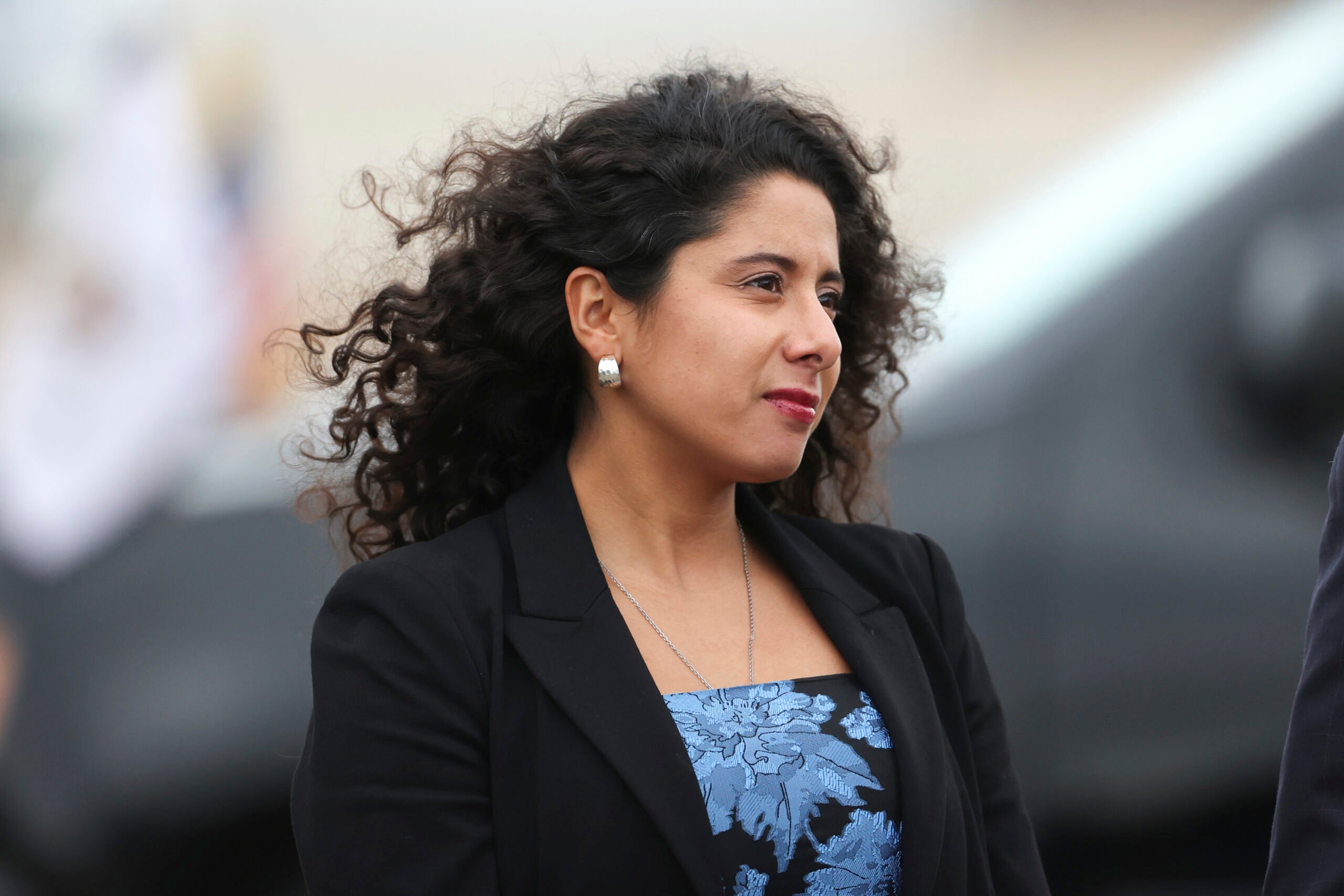 Hidalgo awaits the arrival of Vice President Kamala Harris in Houston in November 2023. (Reginald Mathalone/NurPhoto via AP)
All this led up to Hidalgo’s escalating feud with the “GOP three” (two of whom, again, are Democrats), the budget fight over childcare and raises for county law enforcement, and, ultimately, her announcement that she wouldn’t seek a third term.
Early childcare had been a central subject in Hidalgo, Garcia, and Ellis’ agenda back in 2018, but this year’s rollout of a “penny tax” ballot initiative—which would have added one cent to the property tax rate to create and improve childcare facilities and assist families with childcare costs—was cobbled together at the last minute. A previous iteration of Hidalgo’s childcare initiative had been paid for by COVID-19 stimulus money that was set to run out; Hidalgo released a proposal to extend the policy with a new tax but didn’t consult any county commissioners beforehand, according to The Texas Tribune.
Jesse Ayala, who joined Hidalgo’s office in March to help organize the effort, reportedly knew the rollout was rushed and that Garcia and Briones wouldn’t support a tax increase when their names were set to be on the 2026 ballot. On August 7, the other commissioners killed the proposal and censured Hidalgo for violating decorum in one fell swoop—a month before the Hans Zimmer concert incident, which was prompted by commissioners’ continued refusal to consider the judge’s proposals on various early childhood programs.
After multiple requests, Hidalgo’s office did not provide comment or make her available for an interview for this story.
It’s a discouraging fact of history that progressives on the court enjoyed more power with a 3-2 Democratic majority than today’s 4-1 margin—just as it’s a deflating fact that Hidalgo was once seen as a possible candidate for higher office or a federal cabinet position. Not so long ago, the Dem commissioners appeared to have a collective vision for the county. At the height of Trump 1.0, Garcia, the odd-duck Democrat (a former cop and county sheriff) beside the more-liberal commissioners Ellis and Hidalgo, couldn’t risk the optics of being the only one to side with the two Republicans. Two Democrats siding with one Republican, however, offers the patina of bipartisanship.
Enter Briones, whose “both-and” policy approach has often lead to toxic contradictions: Together, she and Garcia delivered massive raises for Harris County constables—who run a glorified protection racket for wealthy Houston neighborhoods and rarely tackle serious crimes—while initiating the longest county-wide hiring freeze since the Great Recession, cutting myriad department programs including pollution control by hundreds of thousands of dollars and relying on one-time financial transfers to make the numbers work.
The freeze and cuts passed rather quietly in late September, despite the protestations of Hidalgo and Ellis. The pair had lost significant ground after a memorable moment in which Hidalgo, on the day the penny-tax effort imploded, brought dozens of children to the chamber to appeal to the commissioners. The gambit was widely condemned, given that the children, some of whom were in foster care, had no idea what Hidalgo was throwing them into. “It’s one thing for them to be a visual; it’s another thing for them to be a prop,” Ayala, then still in Hidalgo’s employ, told the Chronicle.
When I watched the footage of that afternoon, with Hidalgo begging the kids to come closer to the dais, the children shuffling uncomfortably, unsure what to do, my thoughts turned to Lina’s Army—and the deferred plan to build out a culture of continuously organized participatory democracy. How alone she must have felt, beckoning for an army that did not come.
If there’s one lesson we might draw from Hidalgo’s tenure, it’s that a single election does not change an entire culture. Even the most well-intended technocrat, left to her own devices, might stumble into the familiar trappings of the good ol’ boy system, which exists beyond any of the good ol’ boys themselves. No one, not even Houston Democrats’ brightest star, could change that on her own.
The post Lina Hidalgo Had a Vision. Harris County Won’t See It. appeared first on The Texas Observer.




 English (US)