 (2).png)
 7 hours ago
11
7 hours ago
11
Moizali Momin spent the final months of 2025 bouncing around immigrant detention centers in Texas, Louisiana, and Arizona.
Like tens of thousands of others who were spared deportation under former President Barack Obama, Momin, who came to the United States illegally 26 years ago and settled in the Houston area, where he has a U.S. citizen wife and two teenage children, was vacuumed up by the unprecedented immigration enforcement program of President Donald Trump’s second administration.
Momin was released two days before Christmas, about a month after a federal judge in California ruled against a Trump administration policy that mandates detention for anyone who entered the country illegally, regardless of when and irrespective of their ties to the community or whether, as with Momin, they’re in the process of obtaining legal status.
“I was saying to God, ‘Thank you so much,’” Momin, who’s originally from India, said in a January interview. “I was so happy, you can’t believe that. When I came outside, saw the sun and everything. … I called my friend, my wife and my son. They are so happy.”
But Momin wondered why he, a longtime resident with citizen family members who, unlike many people caught up in Trump’s deportation program, has a shot at legal status, was detained for months and bused and flown thousands of miles around the country, all at taxpayer expense. “What is the benefit?” he asked.
Immigration attorneys say that the cramped, unsanitary detention conditions Momin described—he’s Ismaili, a branch of Islam, and said he wasn’t given food that met his religious diet restrictions—are their own sort of punishment.
“Detention is the easiest way to deport people,” said John Gihon, a former attorney for Immigration and Customs Enforcement (ICE) who now represents immigrants in deportation proceedings. “People who would stay in the country and fight their case on the non-detained docket … [decide] ‘I don’t want to sit in custody at all, I just want to go back to my country.’”
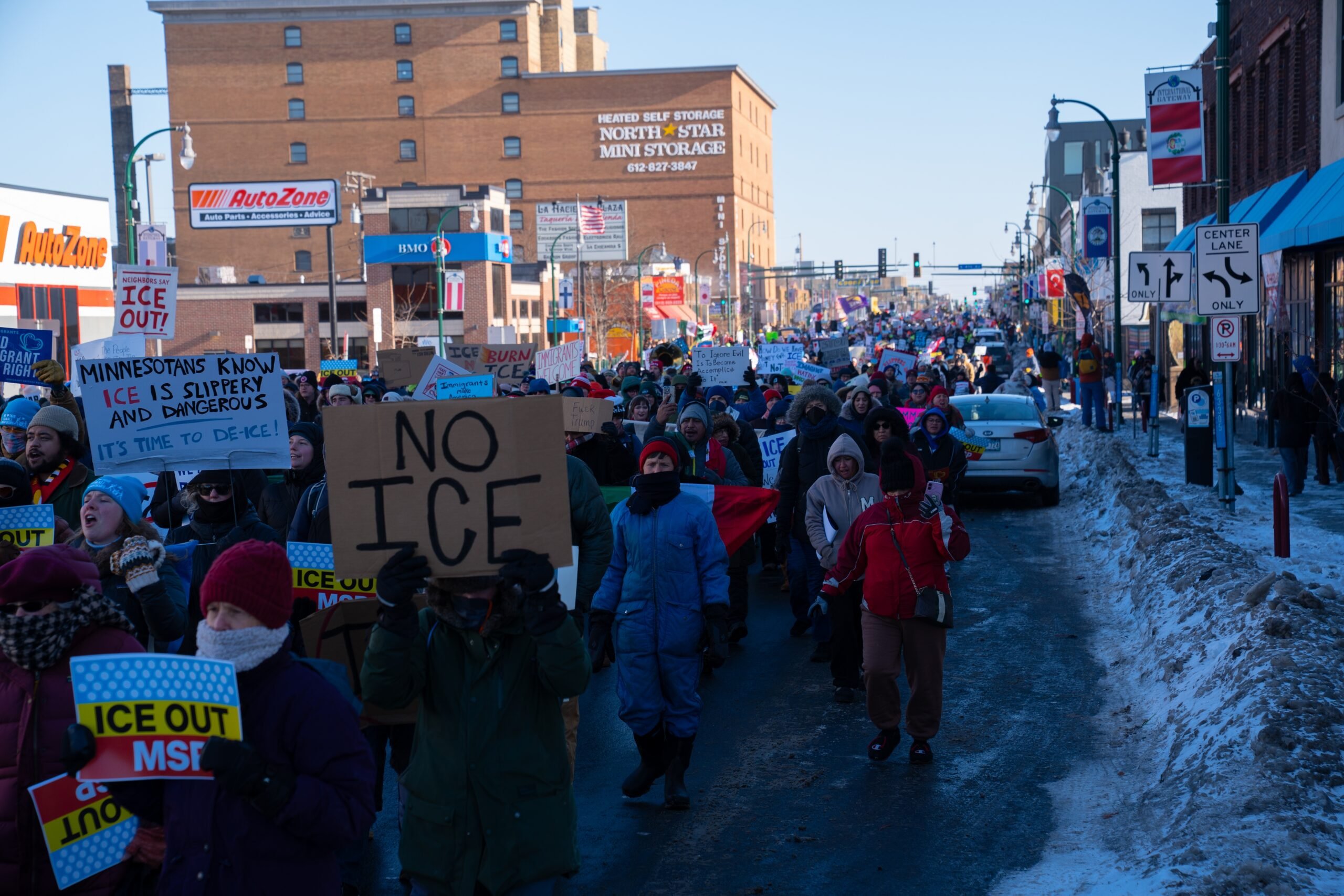 Anti-ICE demonstration in Minneapolis in December (Shutterstock)
Momin entered the country illegally from Canada in 1999. He was quickly arrested at a hotel by immigration officers, issued a notice to appear in immigration court, then driven to a bus station and released. Momin says he didn’t speak English and didn’t understand he was in deportation proceedings. He made his way to Texas, joining an Ismai’ili community near Houston. Unbeknownst to him, Momin said, an immigration judge ordered his deportation in 2000. In the ensuing years, Momin met the woman he’d eventually marry, and they had two children.
It wasn’t until 2015, according to records in a lawsuit Momin’s immigration attorney filed last year seeking his release, that Momin learned about the removal order. Momin, by then the manager of a lighting store, went to an air cargo terminal to pick up merchandise for his employer. When he gave his name to the customs officials, they took him into custody.
At the time the Obama administration had instructed ICE to focus on deporting threats to public safety and to national security. Relying on the doctrine of prosecutorial discretion, a longstanding legal principle that says the government isn’t required to enforce every single law against every single person, longtime residents who were deemed to have strong ties to their communities, even if they were undocumented, were considered low-priority for deportation. Momin was released and put under an order of supervision, a tool immigration officials had used for decades. Such orders were used when someone’s home country wouldn’t accept them after they were ordered deported, or for humanitarian reasons: Someone with a removal order who was caring for a sick U.S. citizen family member might be placed under supervision, for instance, rather than be deported. This increased under Obama’s prosecutorial discretion program, immigration attorneys say.
Momin continued checking in with ICE for the next decade. In 2018, his wife began the process of sponsoring him for a green card; one of the few avenues for people who are undocumented to get legal status is through a U.S. citizen spouse. Many immigrants in similar situations have to return to their home countries as part of this process—a problem Biden tried to address with a 2024 executive order that was blocked by the courts. But Momin’s lawyer said he is exempt from this requirement because his case is so old that it falls under a grandfather clause in the immigration laws.
That legal process was still pending when, early on the morning of August 5, Momin drove from his cul-de-sac-filled subdivision outside Houston to the squat, 1970s concrete office building in northern Houston that houses ICE’s field office. When officers told him he was being detained and would be deported, “I was completely shocked,” Momin said. His first thought was that he was unprepared. He had no money on him or change of clothes. Then he thought of his family. Momin’s wife has suffered from a series of illnesses, including an autoimmune disease, Hodgkin lymphoma, and, most recently, a respiratory disease, according to medical records included in the lawsuit. He wondered who would take care of her, who would pay for his son’s college tuition, and who would take his 15-year-old daughter to basketball practice.
Momin said he was held for three or four hours at the ICE office, then driven to the Montgomery Processing Center in the Houston suburb of Conroe. He was taken to an intake facility, which he described as a sort of holding cell with a glass wall through which the private detention facility’s employees could supervise immigrants.
“That facility is, like, terrible, horrible,” Momin said. “There’s a lot of people in there. A lot. Each room has like 45 capacity. And they’re putting like 60 people in each room. The restroom is a mess. Dirty. People are sleeping on the floor, people are sleeping in the restroom.”
After at least two days—Momin said he couldn’t remember exactly how long he was in intake—he moved to the large, barracks-like rooms with rows of cots for long-term detention.
In September, Momin’s attorney filed a writ of habeas corpus, a civil proceeding before a federal district judge, demanding Momin’s release, arguing ICE never conducted a legally required “individualized review” of his detention and didn’t give him “an opportunity to prepare for an orderly departure.” The next day, Momin’s phone account at the detention center in Conroe was canceled, according to court filings. It wasn’t until he called his family several days later, using another detainee’s phone privileges, that they learned ICE had transferred him to a detention center in Arizona, where he was scheduled to be put on a plane and deported back to India.
In an interview, Momin said that he had been rousted from bed in Conroe at 5 a.m. and driven, shackled hand and foot, to another facility in Houston, then to Louisiana, where he sat on the bus for another four hours before he was loaded on a plane and flown to Arizona. (In court, Justice Department lawyers said the timing of Momin’s flight to Arizona was based on when the Indian consulate issued travel documents ICE needed.) After three or four days at a detention center, in the same clothes, without a shower, Momin said, he was told he’d be deported. The following afternoon he was bused to an airport.
Back in Texas, Simon Azar-Farr, Momin’s San Antonio-based immigration attorney, was frantically trying to prevent the deportation. The same day Momin was taken to the airport, a federal judge in Houston signed a temporary restraining order preventing ICE from removing him.
Momin said he was returned to the Arizona detention center, spent another couple of hours in intake, which he said didn’t have the same overcrowding issues as the detention center in Conroe, before being allowed to sleep on a cot and finally getting a shower. Some time late the next night or early the following morning, he was taken to another room where he waited around 10 hours, shackled again, then was flown back to Texas. Back in Conroe, Momin said, he went through the same overcrowded intake facility.
Momin stayed in Conroe until early October, when he was yet again shackled, loaded on a bus, and driven to a detention center in Livingston, Louisiana, where more detainees boarded. The bus continued to an airfield, where Momin said he assumed he’d be deported to India. He contemplated being dropped in the country he hadn’t seen for 26 years, one that’s plagued by persecution of Muslims.
“This is the second time this is happening,” Momin said in an interview. “I was crying, because nothing is ready. I don’t have the money. I have [dirty] clothes with me. … How can my family see this person coming back after 26 years? How are my parents going to feel?”
One by one, people on the bus were called by name to be led off and board the Boeing 737 Momin could see parked on the tarmac. “Lucky me, they said ‘The plane is full, we’re taking you back to Livingston,’” Momin said.
In the meantime, Azar-Farr had asked an immigration judge in New York to reopen Momin’s removal proceedings. She did, then stayed his removal. Eventually, she rescinded the old removal order, finding that deporting Momin would be a hardship to his family and taking into account that he had the opportunity to legalize his status.
Momin was no longer at risk of imminent deportation, but the removal proceedings against him were still open. Under past presidents, including the first Trump administration, Momin would have been given the opportunity to ask ICE to review his case and decide whether he was eligible for bond. If the agency refused, he could ask an immigration judge. But in July, the Department of Homeland Security (DHS) had implemented the Trump policy that immigrants who’d entered the country illegally could no longer receive bond. In September, the Board of Immigration Appeals, a division of the executive branch that oversees immigration courts, agreed that immigration judges don’t have authority to set bond for people who entered the country illegally. So Momin was kept at the facility in Conroe until late December—after that federal judge in California ruled against the bond restriction—when Momin paid $5,000 and finally returned to his family. (Late last week, a 5th Circuit appeals court panel diverged from the California judge, finding in favor of the Trump administration’s bond policy, casting doubt on how cases like Momin’s in Texas will now play out.)
In a statement, ICE spokesperson Timothy Counts defended Momin’s arrest, saying that the latter’s petition for a green card could not have been processed until after his removal order was rescinded in October. “ICE transferred Momin on several occasions to a staging area in an attempt to carry out his removal, however, each time various last-second filings by his attorney delayed his removal,” Counts wrote in an email.
Counts said that Momin had not requested a religious diet while in detention in Conroe, adding that the center had not exceeded its capacity while Momin was detained nor had detainees slept in the restroom. “Furthermore, the Montgomery Processing Center is one of the most well-equipped detention facilities in the world providing detainees with a safe, secure and humane living environment and a quality of life that far exceeds industry standards,” the spokesperson wrote.
Momin’s case illustrates the reality that the Trump administration is not focusing its detention and prosecution resources on the so-called worst of the worst, even as ICE detention swells to record-breaking levels. Some in the administration were never shy about this: Tom Homan, a former high-ranking ICE official and currently Trump’s border czar, said at 2024’s National Conservatism conference: “No one’s off the table. If you’re here illegally, you better be looking over your shoulder.”
That philosophy has manifested itself in the second Trump administration’s willingness to disrupt the lives of everyday Americans to carry out its immigration agenda. In blue states, thousands of federal agents have descended on major metropolitan areas to carry out deadly street sweeps. In Texas, people like Momin, who were considered by past administrations to be too important to their families and too unthreatening to the nation to be deported, are now low hanging-fruit even if they have Congress-created pathways to legalization.
“Those people should be given every opportunity to seek the relief they’re eligible for,” Gihon said. “Why are we creating rules or laws, then not giving people the opportunity to use them?”
Though he’s Ismai’ili, Momin’s family celebrates a traditional American Christmas, putting up an artificial tree and lights. After his release, instead of a large gathering with extended family, he and his wife and children exchanged gifts among themselves. Though he’s in the process of getting his legal status, Momin said he lays awake at night sometimes, worrying. He’s afraid that if he’s forced to return to India, his wife, who’s Pakistani, won’t be able to join him.
“Now he’s out, and his case just goes on until he is able to obtain his permanent residency,” Azar-Farr said. “So a serious person should ask, I think, ‘What exactly was the benefit of all that detention?’ If he’s got a case and he’s pursuing it, what was the point of putting him in jail for 5-and-a-half months?”
The post How Trump’s ICE Is Locking Up Longtime Texans with Paths to Legal Status appeared first on The Texas Observer.




 English (US)